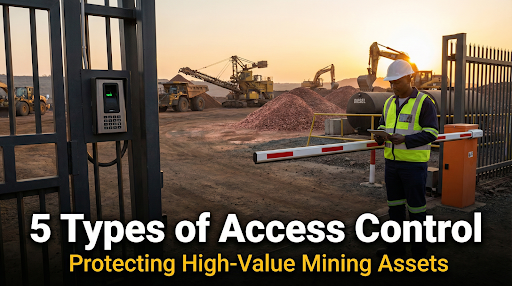
If you’re managing copper, machinery, or diesel in Mpumalanga’s mining belt, the wrong access control system isn’t just inconvenient—it’s a liability.
In South Africa’s industrial heartland, 83% of industrial theft occurs through authorized access points. The problem isn’t usually a breach of the perimeter; it’s what happens after the guard waves a vehicle through.
Are your guards actually controlling access, or are they just “writing names in a book”? Let’s break down the five types of access control through the lens of what actually matters for mining supply chains and logistics yards.
1. Discretionary Access Control (DAC): The “Trust Me” System
How It Works: The owner of a resource decides who gets in. For example, a foreman decides which contractors enter the workshop. It’s permission based on personal discretion.
- The Risk: There is zero audit trail. Permissions are often passed around informally, creating a “liability nightmare” if assets go missing.
- Reality Check: DAC is how “authorized” people walk off with copper. It rarely passes a PSIRA compliance audit.
2. Mandatory Access Control (MAC): The Lockdown
How It Works: A central authority assigns strict access levels (like “Top Secret”). Users cannot change permissions—no exceptions, no favors.
- The Risk: It is extremely rigid and can slow down fast-paced operations.
- Reality Check: While usually overkill for commercial sites, the principle of central control is something every mine should adopt.
3. Role-Based Access Control (RBAC): The Industrial Sweet Spot
How It Works: Access is assigned based on a job title, not a person. A “Weighbridge Operator” gets access to the loading bay; a “Contractor” only gets site access during their shift.
- Why It Works: It’s easy to manage. If an employee leaves, you revoke the role, and all access is gone instantly.
- Implementation: Perfect for pairing with biometrics and vehicle tracking.
4. Rule-Based Access Control: The “If/Then” System
How It Works: Access is granted based on specific conditions, focusing on when and where.
- Example: IF a vehicle weight exceeds the limit, THEN alert the control room. IF it’s after 18:00, THEN deny contractor access.
- Pro Tip: Combining RBAC (who you are) with Rule-Based (when you are there) is the gold standard for high-security sites.
5. Attribute-Based Access Control (ABAC): The Smart System
How It Works: This evaluates multiple factors at once—department, location, and even training certifications.
- Example: A contractor is only allowed in the “Blast Zone” if their safety induction certificate is still valid in the system.
- Reality Check: This is highly effective for large mining groups with complex compliance needs, though it requires more tech infrastructure to run.
The Verdict: What Actually Works?
For Operations Managers in Mpumalanga, the winning formula isn’t just picking one—it’s a combination:
- RBAC Foundation: Define clear roles for everyone on site.
- Rule-Based Restrictions: Lockdown access during off-shift hours.
- Human Supervision: Technology is only as good as the people managing it.
The best system in the world fails if the control room doesn’t answer or the reports sit unread. Real security requires real-time monitoring.
Is your current security truly protecting your assets? Would you like me to draft a custom Site Security Audit Checklist based on these five systems to help you identify gaps in your current operation?